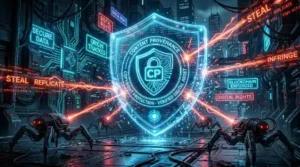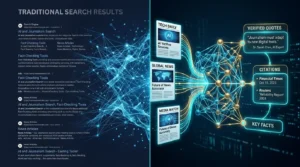
The architecture of the World Wide Web is undergoing its most radical transformation since the advent of the graphical browser. As generative AI models proliferate across search engines, social platforms, and enterprise tools, the web has evolved into a synthetic ecosystem. In this environment, human-created media—photographs, illustrations, digital artwork, and journalistic reporting—is continuously scraped by automated AI agent crawlers to train massive foundational models or populate real-time retrieval-augmented generation (RAG) pipelines.
For content creators, digital publishers, and media organizations, this shift presents an existential challenge to intellectual property rights. Traditional copyright enforcement mechanisms, such as DMCA takedown notices, are ill-equipped to handle the speed and volume of automated data ingestion. To preserve the value of original human work, two critical defensive frameworks have emerged at the forefront of digital rights management: precise crawler policy governance and cryptographic provenance metadata via C2PA watermarking.
The Threat of Unchecked AI Agent Crawlers
Historically, web crawlers operated on an implicit value exchange: a search engine bot scraped a webpage’s content, indexed it, and returned value to the publisher in the form of organic user referral traffic. Modern AI crawlers break this economic contract.
AI crawlers are generally divided into two distinct categories:
- Model Training Bots: Autonomous scrapers (such as GPTBot, CCBot, ClaudeBot, and Meta-ExternalAgent) that harvest mass web data to train generative models. These bots consume bandwidth and origin server resources without sending direct referral traffic back to the content owner.
- Real-Time Retrieval & Search Bots: Live fetching agents (such as ChatGPT-User, PerplexityBot, and OAI-SearchBot) that retrieve up-to-date web pages to answer specific user queries with direct attribution and citation links.
Without clear directives, training bots ingest high-resolution images, original photography, and bespoke artwork, feeding them into diffusion models that can subsequently replicate a creator’s distinct artistic style. To counter this, publishers must actively manage their web server configurations and deployment policies to dictate which bots are permitted to consume their intellectual property.
Implementing Defensive robots.txt Protocols
Publishers can enforce precise boundaries at the server level by explicitly configuring their robots.txt file. The goal is to restrict unauthorized model training scrapers while allowing search retrieval bots that drive citation traffic:
# BLOCK: High-Volume AI Training Scrapers
User-agent: GPTBot
Disallow: /

User-agent: CCBot
Disallow: /

User-agent: ClaudeBot
Disallow: /

User-agent: Meta-ExternalAgent
Disallow: /

# ALLOW: Real-Time AI Search & Retrieval Bots
User-agent: ChatGPT-User
Allow: /

User-agent: PerplexityBot
Allow: /
What is C2PA Watermarking? Cryptographic Provenance Explained
While blocking crawlers via robots.txt prevents automated batch scraping, it does not stop content from being downloaded, altered, re-uploaded, or harvested via third-party scrapers that ignore standard web protocols. Once an image or video leaves your server, traditional metadata (like EXIF data) can be easily stripped away.
This is where the standard developed by the Coalition for Content Provenance and Authenticity (C2PA) changes the paradigm. Formed by industry leaders including Adobe, Microsoft, Intel, Arm, and the BBC, the C2PA framework establishes an open technical standard for attaching verifiable, tamper-evident Content Credentials directly to digital media files.
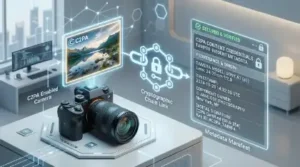
Unlike traditional visual watermarks—which disrupt the visual aesthetic of a photo and can be cropped out or erased using AI inpainting tools—C2PA operates at the cryptographic layer. It embeds a signed manifest (often referred to as a “nutrition label” for digital media) inside the file container itself.
How C2PA Content Credentials Function
- Origin Capture & Signing: When a photo is taken or created, a C2PA-compliant camera, software suite, or AI generator compiles assertion metadata (author name, timestamp, device details, edit history, and AI usage disclosures).
- Cryptographic Binding: A public-key infrastructure (PKI) algorithm creates a cryptographic hash of both the media asset and its metadata manifest. The claim is signed using a private key from a trusted Certificate Authority.
- Tamper Detection: If a rogue crawler or user modifies the pixels, attempts to strip ownership details, or alters the file structure, the cryptographic hash link breaks instantly. Compliant web platforms and C2PA validation viewers will immediately flag the asset as tampered or unverified.
Protecting Digital Media Copyright in the Synthetic Web Era
Combining AI agent crawler governance with C2PA metadata binding forms a dual-layer defensive posture for digital rights management in the synthetic web era. Here is how this integrated defense protects creators and media publishers across three vital dimensions:
1. Enforcing AI “Do Not Train” Assertions
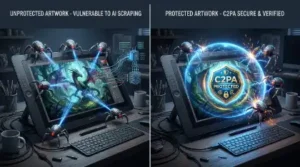
The C2PA technical specification includes standardized schema assertions that explicitly declare training rights. Creators can embed a machine-readable flag stating c2pa.training-mining: false inside the signed manifest. Responsible AI developers that build ethical data ingestion pipelines check these cryptographic assertions before feeding media assets into training datasets, granting artists legal and technical leverage.
2. Combating Unauthorized Deepfakes and Style Scraping
As synthetic media generation costs approach zero, bad actors frequently scrape brand imagery or photographer portfolios to build custom LoRA (Low-Rank Adaptation) models or generate misleading synthetic deepfakes. C2PA credentials provide verifiable proof of origin. News outlets, stock agencies, and commercial clients can verify the authenticity of an image back to its original creator, neutralizing the impact of unauthorized clones.
3. Preserving Copyright Attribution Across Platform Redistribution
When media moves across social networks, content aggregation hubs, and AI-driven answer engines, raw text copyright notices are routinely lost. Because C2PA Content Credentials reside within the asset structure and can be cross-verified via cloud manifest registries, attribution remains persistently attached to the file wherever it travels across the web.
Strategic Action Plan for Content Publishers
To effectively safeguard your digital media assets against aggressive automated scraping and copyright infringement, consider executing the following technical roadmap:
- Audit Server Logs Regularly: Analyze your web server logs to distinguish between legitimate search engine indexing traffic and unauthorized AI scraper spikes.
- Update robots.txt and Edge Controls: Implement strict user-agent blocking rules for model training bots at both the web server and Cloudflare/CDN edge layer.
- Adopt C2PA-Compliant Editing Workflows: Utilize creative software (such as Adobe Photoshop or Content Authenticity Initiative tools) that automatically signs exported media assets with C2PA Content Credentials.
- Publish Machine-Readable Attribution: Supplement your site with structured metadata (Schema.org
acquireLicensePageand copyright assertions) to reinforce ownership signals to automated crawlers.
Conclusion
The rise of autonomous AI agent crawlers demands a modernized approach to digital rights management. Relying solely on legacy copyright laws or simple text disclosures is no longer sufficient to stop the unauthorized exploitation of creative work. By pairing server-level crawler management with cryptographic C2PA watermarking, digital publishers and content creators can assert control over their intellectual property, preserve authenticity, and safely navigate the synthetic web era.